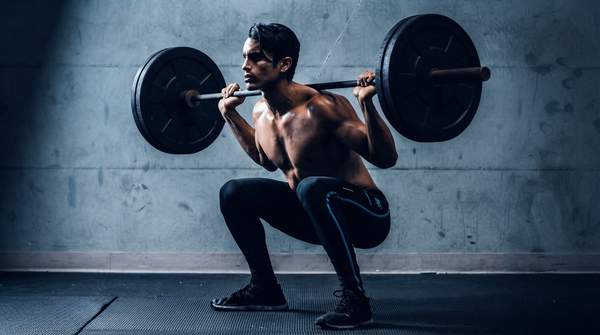
If your squat stalls, the answer is rarely "squat more." It's usually "squat smarter": diagnose the specific weak point—rounding upper back, collapsing trunk, or a hip-versus-knee strength imbalance—and pick the barbell variation that loads that limiter hardest. Bar placement is the lever. Moving the bar from your back to your front rack to the crook of your elbows changes torso angle, joint moments, and which muscles give out first. Here's how to match the tool to the weakness.
Diagnosing Your Squat Weak Points
Weak points show up as repeatable failure patterns. If your chest dumps forward and your upper back rounds under heavy loads, your thoracic extensors are the limiter. If your trunk flexes and you lose bracing mid-rep, core stability is the issue. If you tip forward out of the hole and miss lifts, powerlifting coach Chad Wesley Smith of Juggernaut Training Systems points to a lack of low back and glute strength as a common culprit. And if you can grind through hip-dominant positions but die when the demand shifts to your quads—or vice versa—you have a knee-extensor versus hip-extensor imbalance.
One caution before you self-diagnose: the differences between variations are real but modest. As a CrossFit biomechanics overview puts it, "All squat variations train the same major muscle groups, just with subtle differences in emphasis depending on bar placement and joint angles." You're choosing a bias, not a different exercise.
The Biomechanics of Bar Placement: How Variations Change the Game
Every squat is a negotiation between the barbell's pull and your trunk's ability to resist it. Physical therapist Samuel Spinelli of Citizen Athletics explains that the bar's position on your body determines how much force your back extensors must overcome—the further the load sits from the muscles counteracting it, the longer the moment arm and the greater the demand on your trunk. That's why bar placement is the master variable: it sets torso angle, which sets how far the knees track forward versus how much the hips flex, which in turn shifts work between the quadriceps and the posterior chain.
A biomechanical review by Rachel Straub and Christopher Powers in the International Journal of Sports Physical Therapy frames this as knee-extensor bias versus hip-extensor bias: a more upright torso with knees tracking forward loads the quadriceps, while greater forward lean loads the hip musculature. Neither is "correct"—they're dials you can turn.
Front Squat: Targeting Thoracic Extension and Quad Strength
With the bar racked across your fingers, collarbone, and shoulders, the load sits in front of your body. To keep it there, your torso must stay vertical and your elbows high, which demands mobility at the wrists, shoulders, and thoracic spine. The upright posture reduces hip flexion but increases ankle mobility demands, since your knees must track further forward to stay balanced over the load.
The payoff is twofold. First, the more vertical torso places slightly more emphasis on the quadriceps and slightly less on the hips and posterior chain compared to the back squat—useful if quad strength is your limiter. Second, and often more decisive: as the CrossFit biomechanics analysis notes, "A common limiter in the front squat is not leg strength, but thoracic spine extensor strength." If your upper back rounds, the front rack fails and the bar drops. That makes the front squat a self-enforcing corrective for weak thoracic extensors.
Zercher Squat: The Ultimate Core and Upper Back Builder
Cradling the bar in the crook of your elbows, front and center, creates the longest moment arm of the three variations. You have to fight to stay upright, which—as Gymshark's Alex Kirkup-Lee describes it—"light[s] up your core and posterior chain, particularly the erector spinae." The Zercher forces you to stay tall, brace hard, and engage your core, upper back, and posterior chain simultaneously.
Don't expect it to replace your quad work: compared to front squats, Zercher squats show slightly lower quad activation, though glute and hamstring activation is similar to other variations. Its real value is diagnostic and corrective. Because the loading position exposes weak links—poor posture, lack of core stability, upper back tightness—and demands you fix them under load, it's the variation of choice when trunk flexion is what's killing your heavy sets.
Back Squat Variations: Emphasizing Hip Dominance and Posterior Chain
The classic back squat targets the glutes, quads, and hamstrings, making it the workhorse for overall lower-body strength. But within the back squat, bar height shifts the bias. Spinelli attributes the difference between low-bar and high-bar positions to the force the back extensors must overcome: the lower the bar, the more forward lean the position permits and the more the hips and posterior chain dominate.
Straub and Powers' clinical framing applies directly to lifters: a hip-extensor bias is preferred "if the goal is to increase the strength of the hip musculature." If you're getting tipped forward and missing lifts because your low back and glutes can't hold position, deliberately training a hip-dominant back squat pattern builds exactly that capacity.
Squat Weakness to Variation Map
Use this table as your prescription pad: find the failure pattern you actually experience under heavy load, and program the variation that maximally challenges that limiter. Each recommendation follows the same logic—pick the variation whose bar placement loads your weak link hardest, so it can't hide.
| Weak Point / Limiter | Recommended Variation | Biomechanical Rationale |
|---|---|---|
| Weak thoracic extensors / upper back rounding | Front Squat | Anterior bar placement forces an upright torso and high elbows; if the thoracic extensors fail, the rack collapses—so the variation directly trains them. |
| Poor core stability / trunk flexion | Zercher Squat | Bar in the crook of the elbows creates a long moment arm, heavily challenging the anterior core and erector spinae to hold you upright. |
| Knee-extensor weakness / quad-limited sticking points | Front Squat | The upright torso shifts emphasis toward the quadriceps and away from the hips and posterior chain compared to the back squat. |
| Hip-extensor weakness / getting tipped forward (glutes, low back) | Back Squat, hip-extensor bias | Greater forward lean loads the hip musculature—glutes, hamstrings, and low back—building the strength that keeps your chest up out of the hole. |
Applying the Right Tool: Practical Steps for Stronger Squats
First, film your heavy sets and identify where the lift actually breaks: chest dropping, trunk folding, or hips shooting up while the bar stalls. Second, program the matching variation as a secondary lift in your training week—front squats for thoracic and quad demands, Zerchers for trunk stability, hip-biased back squats for posterior chain strength. Third, let the variation's built-in failure point be your feedback: if your front rack holds and your Zercher position stays tall under progressively heavier loads, the weak link is closing.
Remember the boundary conditions: these are subtle biases, not magic. All variations train the same major muscle groups, and this guidance assumes you're already proficient in the basic back squat. It's not medical advice, and it doesn't replace rehab for injury.
Empower Your Squat: Choose the Right Tool for Your Weakness
Lifters should strategically select squat variations based on a clear diagnosis of their specific biomechanical weak points to achieve targeted strength improvements. The measurable indicator is concrete: improved form and increased load capacity in your main squat, particularly at previously identified sticking points, after consistent application of the recommended corrective variation. Pick one weak point, apply the matched variation for a training block, and test whether the old failure position now holds under load.
Sources
- Addressing Weak Points | Weak Back in the Squat — Juggernaut Training Systems
- CrossFit | Squat Smarter: How Biomechanics Reveal Your Hidden Weaknesses
- Squat Synthesis: Your Go-To Guide for Squat Biomechanics & Decision-Making - Citizen Athletics
- A Biomechanical Review of the Squat Exercise — IJSPT
- 16 Squat Variations For Power, Strength And Mobility — Gymshark